How to Use VST3 Plugins in OBS Studio: atkAudio Setup Guide
OBS does not load VST3 plug-ins through its built-in VST 2.x filter. Install a VST3 host such as atkAudio Plugin, add it to your microphone, scan for the plug-in and load it there.
You need two installations: the audio effect you want to use and the host that connects it to OBS. Installing the effect alone does not add VST3 support to OBS.
- Before installing: check the format and requirements
- 1. Install the VST3 effect and atkAudio
- 2. Add atkAudio PluginHost to the microphone
- 3. Scan the folder, then load the effect
- Example: load a voice-noise-removal plug-in
- 4. Test the recording, filter order and sync
- Troubleshooting: what is missing or failing?
- Waves StudioVerse is a separate installation route
- Once the host works, choose only the effects you need
Before installing: check the format and requirements
| What you have | How to load it in OBS |
|---|---|
| A compatible 64-bit VST2 effect | Use the built-in VST 2.x Plug-in filter |
| A VST3 effect | Use atkAudio Plugin Host or another compatible VST3 host |
| An AU effect on macOS | Use a host with AU support; it will not appear in the VST2 list |
If a VST2 version already works well, you do not need to switch just to follow this guide. For a VST3-only effect, continue below.
The checked atkAudio 0.34.0 release requires OBS 31.1.1 or newer, in a 64-bit environment. Its developer lists Windows 11, macOS 12 or a recent major Linux distribution. Check both the host and the effect: a host working on Mac does not make a Windows-only effect work there.
atkAudio is available as a free download from the developer and OBS forum resource page. Back up your OBS settings before an OBS upgrade, and do not change a working setup immediately before going live.
1. Install the VST3 effect and atkAudio
- Close OBS.
- Run the audio effect installer. Select its 64-bit VST3 build if formats are offered.
- Download atkAudio from its official page and run the installer for your operating system.
- Start OBS again after both installations.
Use the effect installer where one is provided. Some .vst3 items are bundles containing several files; do not pull a DLL out of the bundle or rename it to make OBS find it.
| System | Common VST3 folder |
|---|---|
| Windows | C:\Program Files\Common Files\VST3 |
| macOS, all users | /Library/Audio/Plug-Ins/VST3/ |
| macOS, your account | ~/Library/Audio/Plug-Ins/VST3/ |
A Windows per-user installation can also use %LOCALAPPDATA%\Programs\Common\VST3. Keep track of the folder selected by your installer. Folder conventions are documented in Steinberg’s VST3 locations guide.
2. Add atkAudio PluginHost to the microphone
- In the Audio Mixer, open the menu for your microphone and choose Filters.
- Click + under Audio Filters and select atkAudio PluginHost.
- Give the filter a useful name, such as the effect you plan to load.
- Click Open Plugin Settings to open the host. Button wording can differ by release.
For voice cleanup, choose the microphone source, not Desktop Audio or your finished microphone/music mix. Processing a combined mix can affect music as well as speech.
3. Scan the folder, then load the effect
- Open Options… in the host.
- Choose Scan for new or updated VST3 plug-ins.
- Check the folders in the scan dialog. Add the actual installation folder if it is missing.
- Click Scan, then wait for it to finish.
- Select your effect from the resulting list and click Load plugin.
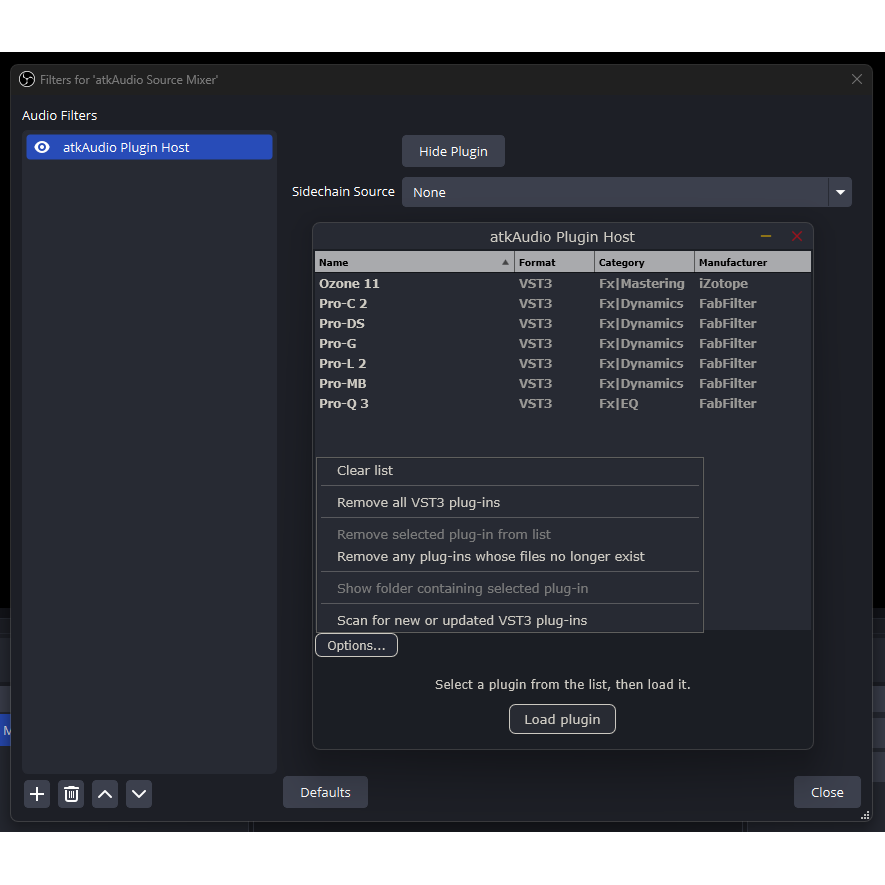
You can close the effect window after setting it up; closing the window is not the same as disabling the filter. If you install another effect later, run the scan again.
Example: load a voice-noise-removal plug-in
NoiLess is an AI noise-removal plug-in for spoken voice. It is one example of a Windows VST3 effect you can load this way; you do not need it if your purpose is a different effect such as EQ or reverb.
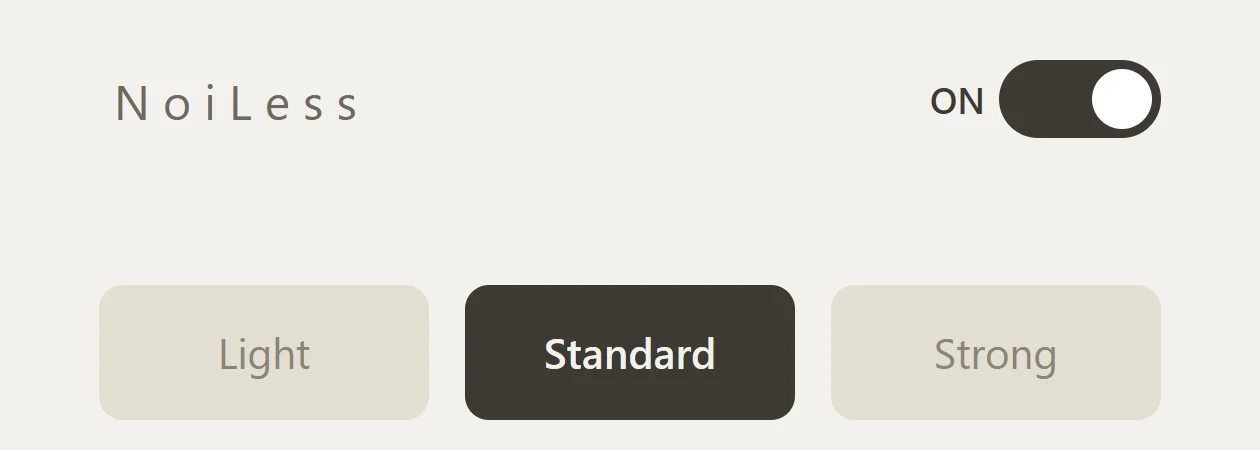
Load NoiLess in the host and start with Standard. Compare Light if processing changes your voice too much, or Strong if unwanted noise still distracts you. Test soft words and typing as well as normal speech. This lets you judge whether cleanup improves your stream without losing words.
The trial has a roughly two-second mute every 45 seconds. That scheduled interruption is not a voice-detection failure. See the official setup guide (Japanese) for the product details.
4. Test the recording, filter order and sync
First record with one effect enabled. For spoken voice, an example chain is noise suppression → EQ if needed → compressor → expander if needed → limiter. Do not add every filter automatically, and avoid stacking several strong denoisers on the same voice.
Compare the recording with and without processing at a similar listening level. Check soft words, loud speech, unexpected dropouts and CPU load during the actual game or app you use.
A delay only in your headphones can be a monitoring issue. Check the recording before adjusting stream sync. If two separate audio sources are out of sync, delay the earlier one. If speech is already late compared with video, reduce the audio-path delay or delay the earlier video; adding a positive Sync Offset to the late microphone makes it later.
To use multiple VST3 effects, you can add separate host filters and load an effect in each. Test after each addition so that a problem can be traced to one change. Advanced PluginHost2 routing is optional, not a requirement for this basic setup.
Troubleshooting: what is missing or failing?
| Symptom | Check first |
|---|---|
| atkAudio itself is missing from the OBS filter menu | Restart OBS, check its version and the OS build of the host installer. Check the actual OBS installation if you keep more than one. |
| The host appears, but your effect is not listed | Use the host scan, not the VST2 list. Confirm the effect format and scan folder, then click Scan. |
| Only one effect fails or crashes | Check that effect’s OS/CPU support, license and required runtime. Use its official installer rather than moving internal files. |
| The effect loads but does not change the sound | Check the correct microphone, the OBS filter enabled state, and the effect’s own Bypass control. |
| Sound cuts out at regular intervals | Check trial/license behavior before increasing gain or reinstalling OBS. |
For a Windows effect that explicitly requires the Visual C++ runtime, use the Microsoft download. Do not download replacement DLLs from unrelated sites.
If an effect causes problems during a stream, disable its OBS filter and return to the last working chain. A plug-in’s internal Bypass may preserve its processing delay, so using that control alone is not always a complete latency test.
Waves StudioVerse is a separate installation route
For Waves effects, follow Waves’ OBS instructions. Its route uses Waves StudioRack for OBS from the VST 2.x filter list to open StudioVerse Audio Effects, with stereo instances. This differs from loading an ordinary VST3 effect in atkAudio.
Waves currently limits its StudioVerse-for-OBS Mac setup to Intel-based Macs. General compatibility in other music applications does not establish support for this OBS route.
Once the host works, choose only the effects you need
The important distinction is simple: VST2 goes in the built-in VST2 filter; VST3 goes inside a VST3 host. Once your effect scans, loads and records correctly, keep that working setup and add further processing only for a specific problem.
If your next step is microphone cleanup, compare free, paid and AI noise-suppression options for OBS. Start with one option and listen to your own voice before buying.
If the effect loads but the result is not what you expected, follow our guides to voice cutouts with OBS noise suppression or keyboard noise while talking.